
Freshness / 01
How old
is what
I’m seeing?
A mark stays on the chart. A reading stays on the dial. The picture keeps its shape after its source has gone quiet, and a finished picture looks current.
We keep asking how a screen should carry the age of what it shows. Six things made here ask it too.
DECISION DOCKET / TWO SHAPES
The same week, in two shapes.
Six fictional items in the manner of a Decision Docket recap, drawn as a river and as a ring. Each one carries the revision it was captured at. Change the shape and watch what the drawing implies about time.
Then follow the six pieces of work below.
This toy needs JavaScript. In words: six fictional items from one week, each with its captured revision; one still waits on you, outside the week.
Authored, fictional items. Not a capture of any real workspace, and not the product’s interface.
WHAT WE KEEP SEPARATEThe source. Its capture. Its age.
A connection can hold while its evidence ages. Each thing on the screen should say when it was true, and never borrow time from the newest thing beside it.
01 / RAIVARI
Raivari
Prototype
Two clocks,
one picture.
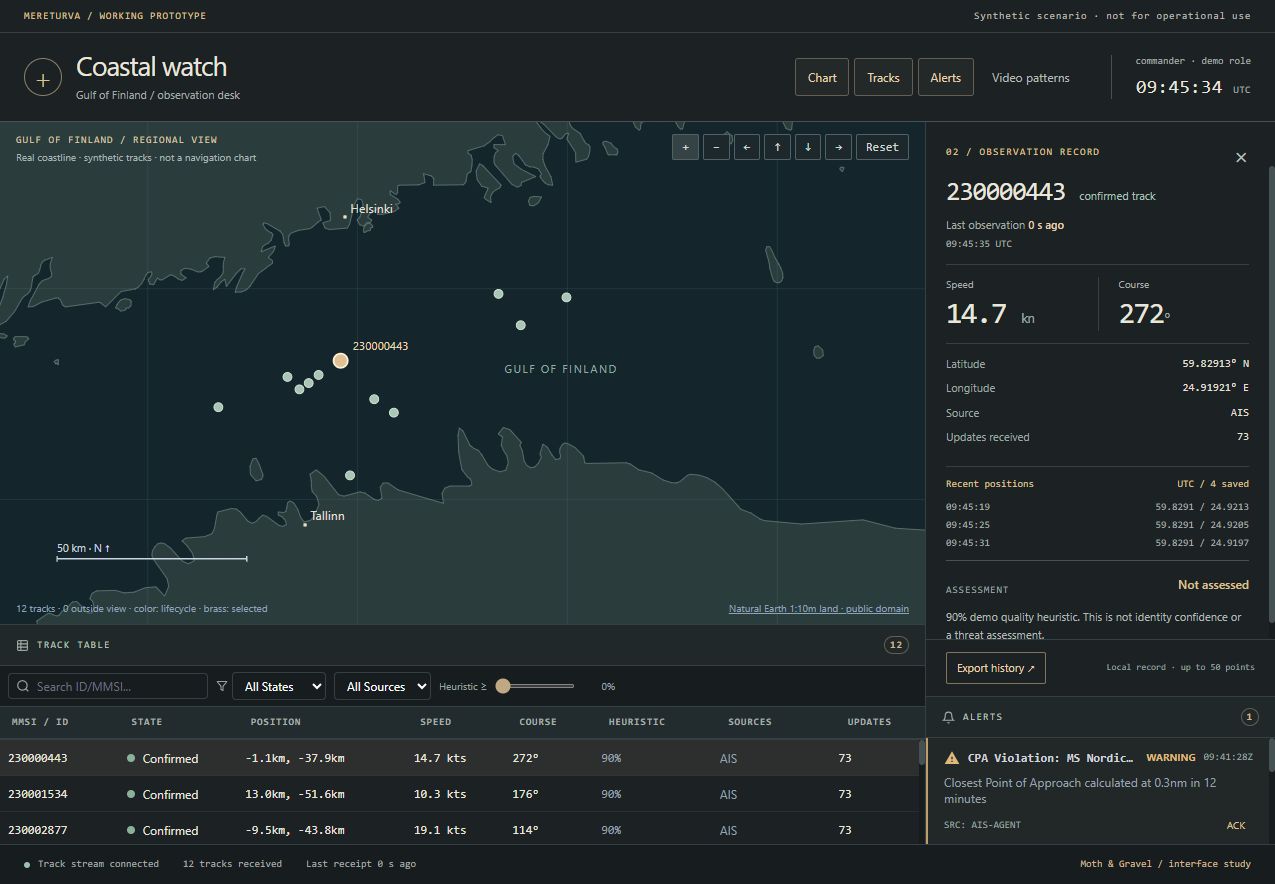
Raivari is the framework under our Coastal watch and maritime studies. In Coastal watch, a message has the time it was observed and the time it was received. A recently received message can describe an older position, so the two ages stay separate.
When the stream stops, the last positions stay on the chart and their age keeps growing beside them. In the maritime study, observed weather, a depicted night and a ship held still each keep their own label.
02 / LIVECONNECT
LiveConnect
Study, parked
Connected
is not current.
A streaming study, now parked. Its code keeps the state of the connection apart from the age of a measurement. The link can hold while the reading grows old.
The specimen lets you turn an inspection clock and watch one reassuring label say too much, beside a version that gives the connection, the measurement and its age a place each.
03 / DECISION DOCKET
Decision Docket
In production for our own work
Captured,
at a revision.
Our own tool for the decisions and evidence behind software work, in production for our own work. A claim about a source carries its address and the revision it was captured at.
A captured revision is a fixed point. The recap can say what was true then; it should not suggest that nothing has changed since.
Shown here only through fictional examples. The real workspace holds private work.
Back to the week, in two shapes04 / MAPPING BUGGY
Mapping buggy
Study
The last packet,
and now.
A small robot in a cardboard arena, and the maps and gauges it leaves behind. Its telemetry dashboard keeps the latest reading on screen; after half a second without a packet, the label changes from Connected to Stale data while the gauges keep their last values.
Its map starts every cell undecided. Free, occupied and not yet known stay three different answers, so a quiet patch of floor does not pass for evidence.
05 / VAHTI
Vahti
Internal tool
Missing
is not zero.
A desktop-browser tool that watches our own Android devices over adb and keeps what it sees as a timeline. How well the data was collected is part of the reading: the cadence expected and observed, the gaps, and the age of the newest sample.
An empty stretch of time stays missing. Absent evidence is recorded as absent, never as a zero that nobody measured.
Our own devices only. No capture of its interface is shown here yet.
06 / SOHVA REMOTE
Sohva Remote
In preparation for Google Play
The card says
what the TV said.
A phone remote for one kind of TV. Its card shows power, channel and volume, but the TV’s own remote, a console or a soundbar can change them unseen. So it asks the TV’s power every five seconds, and says “Can’t reach” only after asking twice, naming only a cause it can see from the phone.
Tried on one TV over two days. In preparation for Google Play, not released.
Follow the question
The question travels.
A field note records a pass through the work. A specimen leaves something you can inspect. The links below keep the two within reach.
FIELD NOTES ON THIS QUESTION
- Read / Field note 012The picture stays.How the age of an observation differs from the age of its receipt.Read the field note
- 019 / The card says what the TV said.
A phone remote asks again; silence keeps its limits.
- 014 / Enough light to read by.
Three kinds of true in one frame.
- 007 / Fast signals. Slow eyes.
- 006 / A map should leave room for doubt.
SPECIMENS AND THREADS
YOUR VERSION
- Bring a picture that looks newer than it is
A rough account is enough. Nothing is sent until you send it.
A question gathered across our own projects: source studies, working prototypes with synthetic data, and one fictional example. It does not establish how people judge the age of what they see.