
01 / SENDER RECORD
—Not yet shown
Back on the net / Begin at the other end
A change can be complete.
A message can still be missing.
Before a serviced communications gateway goes back to a military unit, someone at the other end needs to receive something. Begin here with a measured radio path: follow the packets that arrived, the time they took, and those with no receive record.
A particular constrained VHF bench run, not a general expectation for military networks. The signals-maintenance application is our research question; these are the publisher’s historical packet observations.
01 / THE OBSERVATION CHAMBER
Opening the verified record…
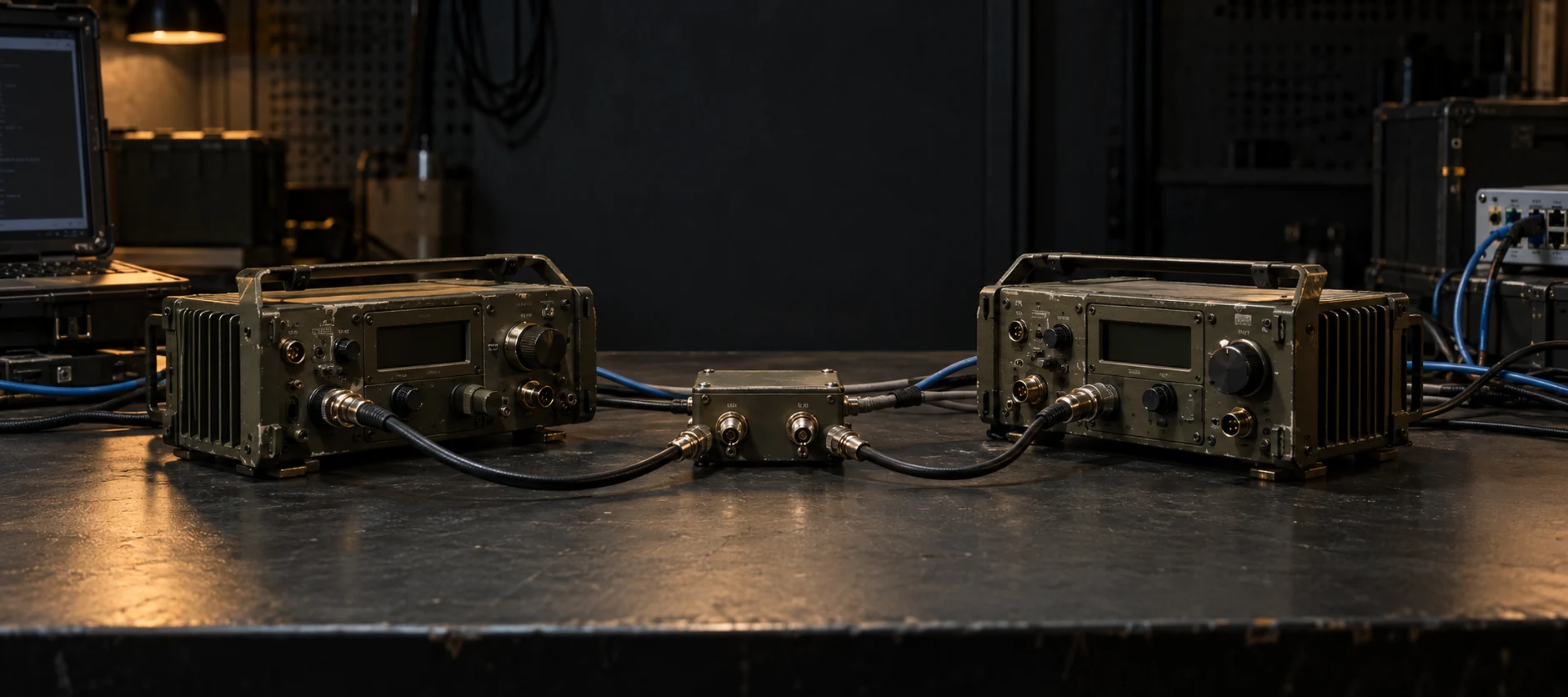
The two capture records have separate clocks and separate evidence.
Selected packetAI-generated illustration. Hardware details, markings and cabling are illustrative, not a technical reference. This is not a photograph of the TNT installation.
02 / THE TIME WEAVE
A thread joins a recorded send to its recorded receive. Its slant is time, not distance. An open stem has no receive observation at this point.
The replay point is outside this packet’s time window. Choose “Follow replay clock” to move the axis with it.
THE CAPTURE / ONE CELL PER SENT PACKET
Choose a cell or use the packet controls. Shapes show observations at the current replay point.
SELECTED CAPTURE RECORD
Opening the record
These navigation buttons use the complete record, including whether a receive row exists. Evidence and export below include only events up to the selected replay point.
Original CSV fields are preserved.
Opening the record…
The receiving capture records a packet. It contains no application acknowledgement, configuration approval or decision to return equipment to service. Those need their own evidence.
Inspect our separate local maintenance account ↗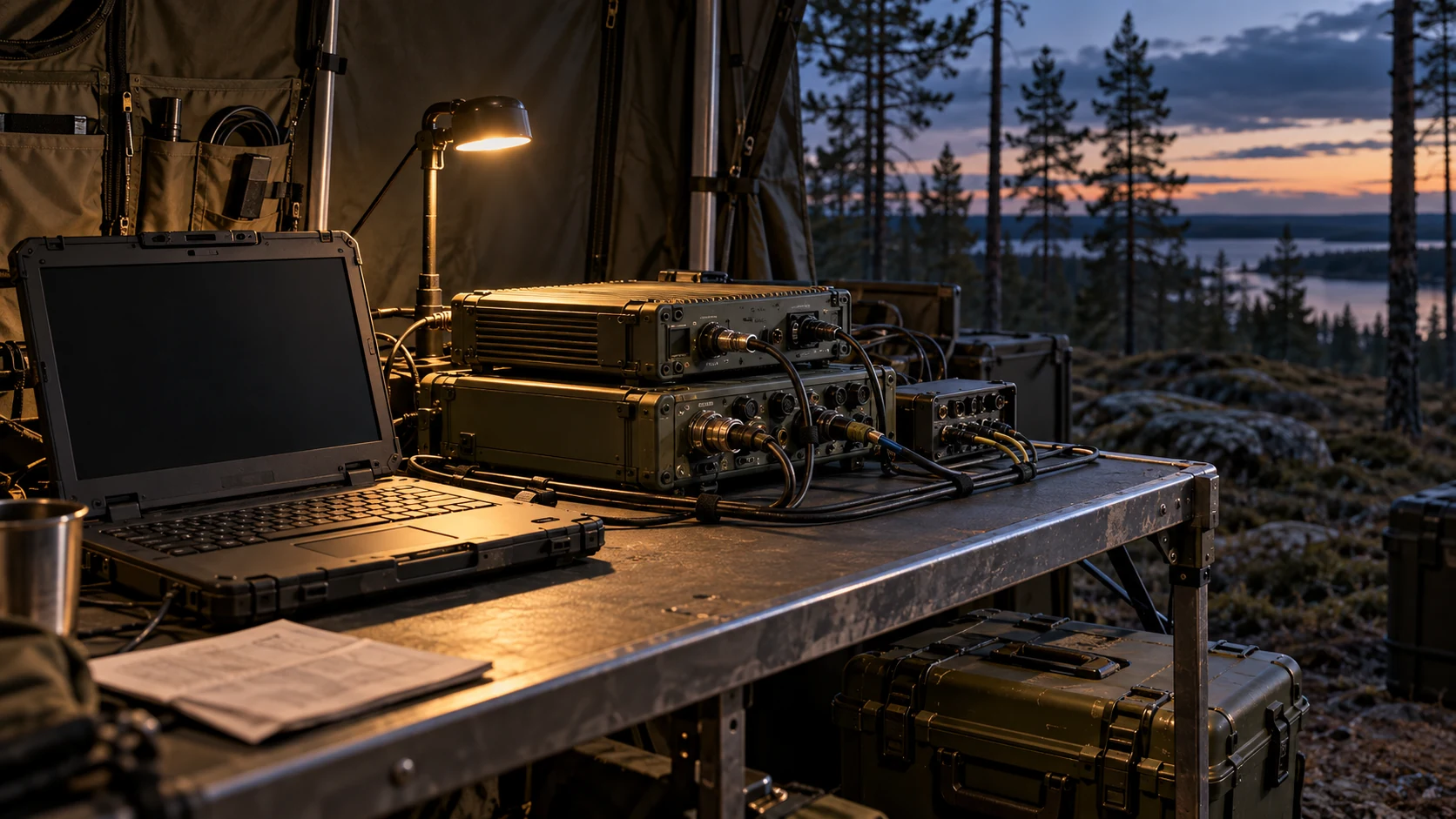
THE APPLICATION QUESTION
A serviced gateway has to work for the person waiting at the other end. Our next step is a new application message, its return acknowledgement, and a handback decision with evidence of its own.
Inspect the separate maintenance account ↗A RECORD WE CAN FOLLOW
TNT is a published tactical-network test platform. Its authors used military VHF radios in a controlled wired bench, with changing network conditions. This view reconstructs one published round from its sender and receiver CSVs. We did not operate the original hardware.
The original files report 7.3% packet loss for this capture. Here a missing receive row is shown as “not observed” only when the full published record is in view. Before that, the record remains awaiting an observation. No arrival is interpolated.
Recorded one-way delay retains the source clocks’ relationship. The CSV timestamps carry no timezone; we have not independently verified clock calibration. Replay runs from the first send to the last recorded event. The publisher’s duration spans the first receive to the last receive; neither is an independent capture-stop timestamp. Changing display speed changes no measurement.
REPRODUCE THE ACCOUNT
IPv4 packet IDs repeat in this run. A naive lookup that keeps the last occurrence collapses 1,000 sender rows to 994 keys and produces five negative apparent delays. Matching each flow’s chronological occurrences reproduces the publisher’s counts and recorded delay statistics. This is an assumption for these files, not a general identity guarantee.
The original CSVs, their hashes, matching method and deterministic builder travel with the study. The publisher’s repository declares GPL-3.0; the source data and this derived dataset are supplied with that licence and attribution.
TNT project and contributors. Version-of-record: Rettore, Loevenich & Lopes, IEEE Access (2022). This is a Moth & Gravel inspection interface, with no implied affiliation or military qualification.