

FIELD NOTE / 010DESIGN STUDY

NOTES ON SMALL DIFFERENCES

Almost
the same.

A small disagreement gives us somewhere to look. The whole picture still needs our attention.

Listen to this note · 5 minAI-narrated

RECORDING / 4:52

Subscribe to the podcast
Downloads
Transcript

Machine-generated from the recording; names and speaker boundaries may need checking.

0:00 Moth and Gravel Field Note 10 Almost the same An AI narrated

0:08 edition of the published note Lay three translucent sheets

0:13 over a color Gather them together first, then lay the

0:18 group down You might expect the same picture In Sky Stack

0:23 Builders Rendering Experiments, that small change can leave a

0:27 small difference The order of the work stays familiar The

0:31 place where it happens changes How closely should two pictures

0:36 agree before we call them the same A difference needs a place

0:42 to look The experimental renderer gathers some painted

0:46 content into a transparent layer before placing it over the scene

0:52 Each draw rounds its color into the available range The final

0:57 composition adds another place where that can happen A simple

1:02 test sets the island aside and draws three overlapping

1:07 translucent rectangles On a green background, the two

1:11 approaches match exactly On another background, thousands of

1:16 pixels differ by a single level in a color channel The

1:20 background matters A tidy answer from one convenient example can

1:26 leave another question untouched Two ways to assemble a picture A

1:32 conceptual diagram of drawing and rounding Not a measured

1:37 pixel image Open the full-size diagram Small is a description,

1:44 not a verdict A one-level difference tells us something

1:49 about the machinery It leaves the design question open Does

1:54 the difference appear along an edge Does it flicker as the

1:58 camera moves Does it change the separation between a character

2:03 and the ground A count alone cannot say how the picture feels

2:08 to someone trying to use it The wider scene comparisons also

2:13 contain much larger differences The small rounding example gives

2:18 us a useful explanation for one kind of disagreement The rest

2:24 still needs attention Look at the whole island A close

2:30 inspection and a whole view serve different purposes One

2:34 helps find a cause The other lets us ask whether the place

2:39 still holds together Remove a troublesome detail and a

2:43 comparison may become easier to understand Put it back before

2:49 judging the island The edge, shadow, or patch of ground may

2:54 be exactly what gives the player a sense of where something

2:58 belongs The next study would show the complete views at the

3:03 size and pace of play Let someone turn the camera and

3:07 choose a block Ask what caught their eye, what seemed to

3:12 change, and whether that change made a choice harder Keep the

3:17 close comparison beside those observations It gives a specific

3:22 disagreement somewhere to live without asking it to decide the

3:26 whole experience Leave room for another look There is pleasure

3:32 in getting two pictures to agree There is useful work in

3:37 understanding why they don't A pixel can give the investigation

3:42 a starting point The person looking at the island gives it a

3:47 reason to continue Study Scope Source Reading

3:54 This study reads Native Rendering Controls and recorded

4:00 scene comparisons The rectangle example found an exact match on

4:07 one background and a one-level channel difference on another

4:12 The illustrations explain the question They are not rendering

4:18 captures No new benchmark or player study was run for this

4:24 note The comparison does not establish that a small color

4:30 difference is always harmless or that the complete renderer is

4:35 ready The proposed observation remains to be done

4:43 You have been listening to Moth and Gravel Field Notes The

4:47 written edition is at mothandgravel.com

Download transcript

Three translucent sage, blue and rose sheets overlap on warm paper beneath a brass magnifying lens.
Looking closely at a small disagreement. AI-generated editorial illustration, not measured colour swatches.

Lay three translucent sheets over a colour. Gather them together first, then lay the group down. You might expect the same picture.

In SkyStack Builder's rendering experiments, that small change can leave a small difference. The order of the work stays familiar. The place where it happens changes.

How closely should two pictures agree before we call them the same?

A difference needs a place to look

The experimental renderer gathers some painted content into a transparent layer before placing it over the scene. Each draw rounds its colour into the available range. The final composition adds another place where that can happen.

A simple test sets the island aside and draws three overlapping translucent rectangles. On a green background, the two approaches match exactly. On another background, thousands of pixels differ by a single level in a colour channel.

The background matters. A tidy answer from one convenient example can leave another question untouched.
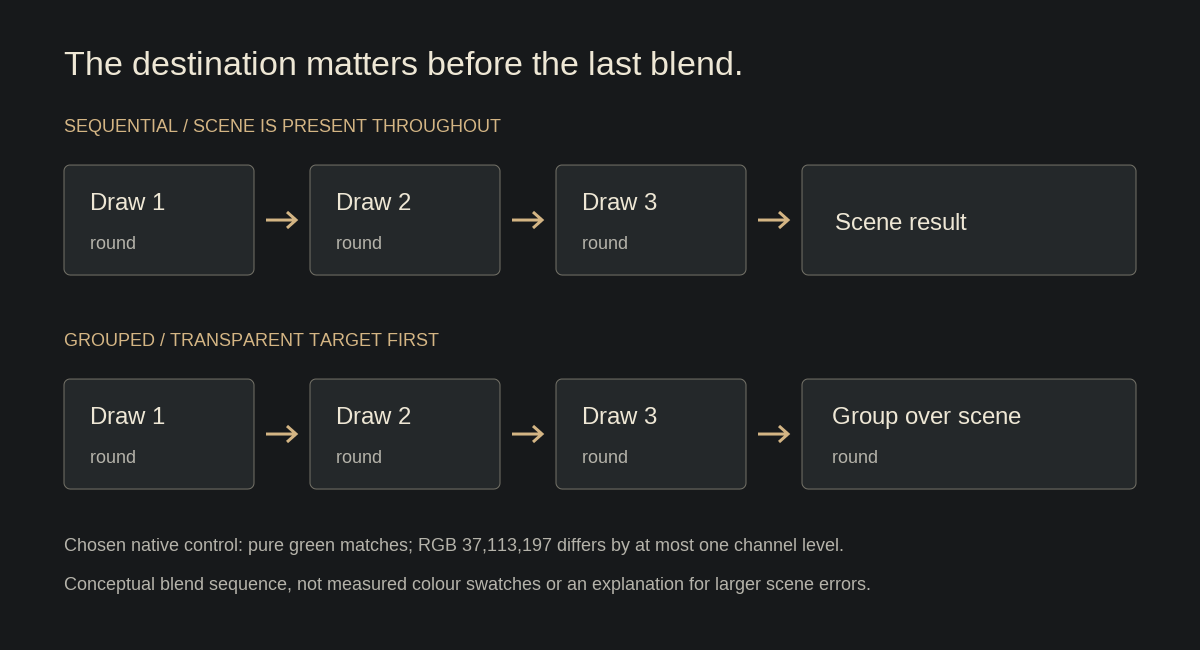
Sequential drawing blends three shapes onto the scene. Grouped drawing blends them onto a transparent layer before placing that layer onto the scene, adding a final rounding step.
Two ways to assemble a picture. A conceptual diagram of drawing and rounding, not a measured pixel image. Open the full-size diagram ↗

Small is a description, not a verdict

A one-level difference tells us something about the machinery. It leaves the design question open.

Does the difference appear along an edge? Does it flicker as the camera moves? Does it change the separation between a character and the ground? A count alone cannot say how the picture feels to someone trying to use it.

The wider scene comparisons also contain much larger differences. The small rounding example gives us a useful explanation for one kind of disagreement. The rest still needs attention.

Look at the whole island

A close inspection and a whole view serve different purposes. One helps find a cause. The other lets us ask whether the place still holds together.

Remove a troublesome detail and a comparison may become easier to understand. Put it back before judging the island. The edge, shadow or patch of ground may be exactly what gives the player a sense of where something belongs.

The next study would show the complete views at the size and pace of play. Let someone turn the camera and choose a block. Ask what caught their eye, what seemed to change and whether that change made a choice harder.

Keep the close comparison beside those observations. It gives a specific disagreement somewhere to live, without asking it to decide the whole experience.

Leave room for another look

There is pleasure in getting two pictures to agree. There is useful work in understanding why they don't.

A pixel can give the investigation a starting point. The person looking at the island gives it a reason to continue.